Mostrando las entradas con la etiqueta canteloupes. Mostrar todas las entradas

viernes, 5 de junio de 2009

fruity

Cool fruits you don't see every day (that i do):

Inga edulis

Inside the massive green pods of the guaba tree, seeds are encased in a velvety white EDIBLE flesh! One taste and you'll understand why it is nicknamed the "cotton candy fruit."
There is huge confusion around the name of this fruit. According to the books it is guaba, but is referred to here in Nicaragua as guayaba.
However, guayaba is translated as the spanish word for guava, a distinctly different fruit with juicy pink fruit and green skin.
Luckily, i enjoy both fruits so whatever i call it, or they call it, i'll eat it!

This might be the weirdest one yet:
Anacardium occidentale

Would you have guessed that this is the fruit and nut we call cashew??! Although the nut has gained international popularity, Nicas rave about cashew fruit and frequently grow the tree for the fruit only.It gets weirder: the nut, or seed, of a cashew is protected in the brownish cashew-shaped shell; inside the shell is a dangerous liquid containing the chemical urushiol, the same irritant in poison oak and ivy: cuidado! The common allergen may seriously injure your skin, not to mention your mouth. For this reason cashews are opened by roasting, steaming, or boiling, a process that should not be undertaken lightly.

Personally, i don't love cashew fruit. the flesh is pulpy, too smooshy for me and not sweet enough.

This one ain't so strange, though you might not recognize it so close up:

how about now?
Cucumis melo reticulatus is regular old canteloupe, and my plant is finally fruiting!!!!!


And, your everyday banana tree, in all its splendor:

jueves, 28 de mayo de 2009

friends in low places

Weeds have such a bad name. as in, bad reputation. There is an entire industry bent on killing, removing, destroying, eradicating weeds, the unwelcome guests at every garden party. And i admit, i was amongst the ranks of such weed-haters not so long ago. Encroaching on my precious cultivated beds, pesky, sometimes spikey persistent invadors! i diligently plucked every eager weed that dare to sprout in my garden plot.
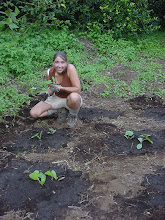
proof: me and my bare soil garden last fall


However, thanks to the kind advice of more experienced farmers than I, my eyes have been opened.
A weed by any other name, is MULCH:

Allowing weeds to sprout up around your crops creates a groundcover that holds in moisture (note: this applies to weeds of shorter stature than your desired crops) even if it does tend to look a little messy.
and when it is necessary to pull tall weeds, use them as regular MULCH, like i did here around mis melones:
All decomposing plant matter contains nutrients, so why not recycle unwanted plants?

And most impressively, weeds can act as CROP TRAPPINGS, as with my papaya sapling:
There are plants out there that are intended to bait pests, thus protecting the farmer's prized crops. in this case, a volunteer crop trapper showed up near my papaya--what a trooper! Not sure what plant it is, but i believe it's the same valiant fall guy pictured here with a baby tomato plant, again taking all the hits so that my cultivated baby can survive:
i guess it's tasty? The tiny round bites suggest an insect pest, though i have also found large jagged nibbles of the rabbit-mouth variety.
Keep up the good work, mis amigos!

sábado, 18 de abril de 2009

critters

i thought it might be refreshing to switch the focus for a bit off las plantas, and onto los animales. because of course, in every healthy ecosystem the animal kingdom exists and interacts with that of the plants, fungus, etc. Granted, we don't have any of the traditional farm animals YET. Once the house is finished and we are living on la finca, our friendly fauna wish list includes un burro, gallinas, una cabra, y 2 perros (a donkey, chickens, a goats, and two dogs).
However, i am not so arrogant as to assume that the farm is absent of animal life. on the contrary! the place is crawling (literally) with both welcomed and pesky critters. A recent arrival heralding the official beginning of the Dry Season are las chicharras whose music, for me, captures the nostalgia of hot muggy summers.
Annual cicada, Tibicen linnei

Above, see the exoskeleton of a chicharra, its crispy outer shell evidence of its final foray in the chicharra life cycle: molting into an winged adult, after anywhere between 2 to 15 years living underground.
These guys are not known to harm crops, save young fruit trees where females may prefer to lay eggs, so what's all the noise about?
HEAR it is! listen to this video clip, recorded at the farm around dusk. Apologies for the poor visual quality.


While i am eternally grateful that chicharras are not the biblical locust plague sent to descend upon my humble garden, and i recognize the VITAL importance of beneficial insects and pollinators, i admit that i am not a huge fan of bugs. That being said, if i had some pics of bees and butterflies i would be eager to celebrate them here, a small slice of internet fame in exchange for providing VIABILITY to my poor little forever-flowering cantaloupes:

Turns out, cantaloupe flowers require pollination for fruit set, otherwise all you get are cute yellow flowers. Sadly, i haven't seen much bee action en la finca, despite the attractive blooms of zillions of flowering "weeds" surrounding the garden. the next step would be something called hand pollination, in which one manually transfers pollen from a male to a female blossom. Call me squeamish, but i'm not sure i'm ok with that? i'm a first-year gardener for crying out loud!

And finally, not to be overlooked, our domesticated yet (occasionally) working farm animals:

You might remember Niña from the compost scandal a ways back, she's a little gal with a keen ear and a fierce bark.

Meet: Negro
a new addition to the farm, currently compost-forage apprentice to Niña, goofy, scrawny, energetic--this was the best i could do for his profile foto

¡y La Zaya!
Formerly a Californian house cat, Zaya spends 5-10 minutes a week honing her hunting skills in preparation for life on a farm. Pictured here with latest kill