Mostrando las entradas con la etiqueta beans. Mostrar todas las entradas

lunes, 11 de octubre de 2010

Hay Nacatamales

Nacatamales are an almost religious culinary tradition in Nicaragua, a gigantic overstuffed tamale with a standard list of ingredients uniform throughout the country. Nacatamales are prepared fresh in locals' homes; in every pueblo there are several infamous residents who display the sign Hay Nacatamales, meaning they are available for sale on Saturday and Sunday.
The Nicaraguan version of the tamale, wrapped and cooked in a banana leaf rather than a corn husk, is large, undeniably a meal in itself. The key ingredient is either chicken or pork, accompanied by rice, potatoes, tomatoes, an olive or raisin, and a leaf of yerba buena. This is the tried and true recipe, delicious, and available for only $1 anywhere you go. Why mess with a good thing? the only reason I attempted my own was the vegetarian factor. 
Based on hints from neighbors and friends, as well as gringo guidance from this online recipe, i set out to make my own vegetarian nacatamale.
First up, and arguably the most important ingredient: masa. Traditional nacatamale masa is made with lard, the ultimate cooking fat. When I asked around about vegetarian substitutions, I was met with chortles, smirks, and a couple of suggestions. Since I was making a large batch, I went with what I had the most of, sunflower oil. 

Using a pre-packaged masa, I added a cup of oil and mixed until it was too thick to stir. Following a tip from an authentic nacatamale recipe, I squeezed a sour orange into the dough, and then a flavorful veggie-based broth and worked it in with my hands.
The masa is then left to sit for at least 30 minutes. Time to prepare my tasty fillings!
I flavored up a batch of red beans and potatoes,
and a soy meat with summer squash medley. These would be the savory protein-rich centerpieces of my tamales.

Assembly!
Wrapping the masa and filling into a banana leaf was the most fun and most challenging part. I am proud to announce that I myself went out on the farm to harvest nice long smooth leaves with few tears. In order to make the leaf pliable, I warmed each one over a gas burner. The leaves must bend and fold over to hold the tamale inside, and I found this method extremely effective.
A small circle of masa is patted out in the center of a leaf, and I learned after my first batch, a dollop of homemade hot sauce keeps the filling from drying out.
Upon this I heaped shredded cheese, a spoonful of either the bean or soy mixture, and a sprinkle of cilantro leaf. With a few, I also added cooked rice. Later, as I recounted this process to some veteran nacatamale chefs, raucous laughter erupted at the mention of the cilantro. Apparently I was breaking all kinds of culinary taboos.
Sorry, don't have any action shots. The wrapping process took a little practice, eventually I got it. My little banana packages came out cute, no?
These guys were all tossed into a pot which I first layered with bunched up banana leaves in the traditional method for steaming. Being somewhat of a modern chica, however, I did cook with my gas stove rather than over open fire.
Unlike the wood fire fueled kitchens of most Nicaraguans, in which a pot of nacatamales takes up to 6 hours to cook, mine were ready to unwrap and enjoy in about one hour.
Not too shabby!
Die hard fans of the original nacatamale may argue that my masa/veggie creation is only that, an inauthentic copycat of a cultural classic. at worst, I could be accused of culinary sacrilege.
Yet, despite altering the sacred recipe, tasters from the veggie as well as the meat-eating contigency report success!

martes, 29 de septiembre de 2009

Garden 911

I don't mean to alarm anyone, but some of my plants need HELP!!
Please pardon my departure from cheery pretty plant posts to lament some of the tough realities in my organic garden.
Maybe you've experienced one of these issues, or you are an accomplished gardener, or perhaps you are simply a nice person with an idea, please feel free to TELL ME WHAT TO DO!

First, have a looksie at my pipian--it is a local variety of squash, soft skin much like a zucchini. This is what keeps happening :(
The leaves develop a white moldy-looking hue, eventually yellow and die, as do any developing squashlings.
In the past my zucchini and yellow squash was decimated by several pests; for educational purposes i will relive these painful moments wherein my cucurbits were prey to striped cucumber beetles, squash bugs, and vine-borers. Yesterday i found evidence of vine-borers once again AND i caught this sneaky lady bug look-alike chomping away.

I am now wondering: Is it the pests causing an untimely demise to my pipian,,,,or is that white stuff a tell tale mold/fungus problem?
?
My garden, though pest-ful, is pesticide free ;) so spraying toxins is out. I do have a concentrated neem oil that i am more than willing to use. I have also employed companion planting and beneficial plants (nasturtium, mint, marigold, borage, garlic) to discourage pest infestations.
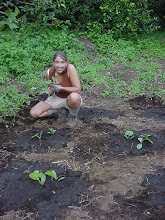
And here, with my pumpkin plantitas (probably started too late for Halloween), is a cute preventative method i read about:
shiny aluminum foil wrapped around the base of the stem, with the intention of foiling those vexatious vine-borers. I'll let you know how it turns out.
Next up in my Plagued Plant Tour, a disappearing leaf incident. Congo chiles are the spiciest type of local chile you'll find in Nicaragua. they are tiny but pack a punch. My congo bush was thriving, until......
one day it had NO MORE leaves! Nada. And this has happened before with another congo, which subsequently shriveled up and died. ¿que paso?
?

Finally, assuming you are not too depressed to keep going, may i submit one more sickling:
Scarlet Runner Bean
Again, not a new issue. The bright scarlet beans sprout and grow about this much before the leaves yellow, curl up a bit, and die. I have not seen any pests. and pole beans have done well in the same area. hmmmmm...
?
That's the sob story. FYI we are in the middle of the Wet Season, buckets of rain almost every day.
I appreciate any advice, suggestions, tips a kind reader might have! or commiseration, or just good-old fashioned pity....
con mucho gusto,
Liz

jueves, 20 de agosto de 2009

full of frijoles

'Tis the season
for BEANS!

A rite of passage for any latin american farmer, this was my first 100% On-My-Own bean crop.

who's counting? me:
Seven pounds planted
twice the rows weeded
ninety days plants grew
20-something pounds harvested (thus far)
lessons learned: innumerable
May 26 i gently tossed the first 2 lbs into 4 shallow rows, the crookedness of said rows being my involuntary trademark design (regardless of how hard i try to plant in straight lines).
A local farmer told us you weed your beans twice during the growing season, ensuring that your beans crop is healthy and low maintenance
note the inescapable (yet groovy?) curves

I didn't know it at the time, but these rows are too CLOSE. once the bean plants thrived and climbed and stretched, i was left with a wild unnavigable tangle of vines.
Bean harvest Nica style consists of a few simple steps:

Yanking up the dried plants and leaving them to sun dry for 4 days. these homemade drying screens work PERFECTLY


Once the pods are thoroughly dry (brown & crackly), the entire plant is stuffed into a sack which is then beaten with a stick. then shook.
Beat,
shake.
Beat,
shake
until the majority of the dry beans are relinquished from their pods and drop to the bottom of the sack. A primitive process perhaps, but highly effective for releasing supressed energy and working your biceps.
The dirt/sticks/leaves must now be painstakingly picked out of the bountiful harvest. At this stage i flubbed up again and "cleaned" the beans in water, thus inciting the sprouting potential of the next generation of bean plants. can you eat red and black bean sprouts? never heard of it before but you sure as heck wouldn't store dry beans wet. hence, i was forced to plant out the sproutlings.
At this point the beans should be laid out in a safe sunny spot to DRY more. i learned this one the hard way when my first few pounds grew a fluffy white mold...

And, despite producing a beauteous visual effect, the colorful red + black combo was unintentional....another consequence of planting rows of frijoles negros too close to rows of frijoles rojos, not to mention culinary taboo in the eyes of red bean loyal Nicas.