Mostrando las entradas con la etiqueta pests. Mostrar todas las entradas

domingo, 25 de julio de 2010

Insectos: from creepy to copacetic


Rainy season brings out all the best (and worst?) critters. Typically when I discover an uninvited guest of the creepy crawly variety in the house, it is quickly and carefully relegated outdoors (notable exceptions are cucarachas and scorpians, both killed on the spot).

I was prompted to do a bit more research recently in order to identify the following many-legged ones found in my bedroom. I had a strong suspicion one or both might be poisonous.

The first,
most likely a millipede though I didn't get a leg count before ushering it outside. Millipedes feed primarily on decaying plant matter, so no big threat there. They can, however, produce an "irritating fluid" when disturbed. gross.

Next, less leggy though slightly more menacing,


some kind of centipede, a carnivorous insect with a set of sharp claws that contain venom and can inflict a painful bite! The very large varieties can harm humans; I think this guy is small enough to be considered inoffensive; nonetheless he was removed to the outdoors as well.

A safer distance from my bed, on the exterior door of the house, I happened upon this gorgeous and unusual spider and her web.
Click on the image to get a closer look--it's worth it ;)

Undeniably elegant and cheery, the butterflies emerge in full force after a heavy rain, dipping in water droplets and nibbling on fruit.
Here they feast on a juicy opening in a mango still on the tree.

Below, they converge upon the mango pit I am sun-drying before planting.

sábado, 24 de octubre de 2009

TomatObession

In the manner of all obsessions, I didn't realize it was happening until it was too late. A little spaghetti here, a bowl of chili there. A BLT for lunch, a zippy pico de gallo as a snack. Before I knew it, french fries, burgers, and dogs all were naked without ketchup; friday night was and is eternally Pizza Night; and every salad is incomplete without fresh sliced tomatoes.

Needless to say, when I prepped my first garden plot last year, tomatoes were at the top of my plant list. little did i know....

tomatoes are very sensitive. Factor in my severe wet and dry seasons and newbie gardener skills, bam: the perfect recipe for disaster.
In my desperation, I have gone so far as to grow tomatoes upside-down, hanging in a bucket. The latest of such experiments ended up with late blight, a yucky fungus that will ultimately destroy your plant and spread to others.
However, the reason i write today is not to whine, oh no. On the contrary, a pledge to persevere. Rest assured: this is not a passing fancy, a forgettable whim. Deliciously homegrown tomatoes remain my fixation and despite discouraging setbacks, I will not be deterred.

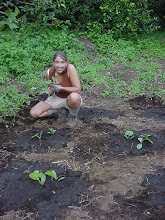
Selecting from an impressive assortment of tomato seeds that kind visitors smuggled in for me over the past year, i picked out disease-resistant varieties.
My latest crop has been fortified with preventative measures of every sort:

  • To reduce contact with soil, i.e. soil-born fungi, i have mulched with newspaper and cardboard.
  • Note that the plants are raised on mounds, allowing the heavy and frequent rains to run off rather than collect in moldy puddles.
  • The tomato bed is surrounded by beneficial plants: anti-fungal garlic, nematode-resisting marigolds, & pollinator-attracting borage
  • Branches are appropriately staked on string, & low hanging limbs and leaves are removed immediately to prevent mud saturation
My efforts are already paying off:
happily fruiting tomatoes!

To the early blight and late blight, blossom end rot, tomato hornworm, leafminers, and creepy red spider bugs: Gracias for humility & first hand experience; the tomato quest prevails!

martes, 29 de septiembre de 2009

Garden 911

I don't mean to alarm anyone, but some of my plants need HELP!!
Please pardon my departure from cheery pretty plant posts to lament some of the tough realities in my organic garden.
Maybe you've experienced one of these issues, or you are an accomplished gardener, or perhaps you are simply a nice person with an idea, please feel free to TELL ME WHAT TO DO!

First, have a looksie at my pipian--it is a local variety of squash, soft skin much like a zucchini. This is what keeps happening :(
The leaves develop a white moldy-looking hue, eventually yellow and die, as do any developing squashlings.
In the past my zucchini and yellow squash was decimated by several pests; for educational purposes i will relive these painful moments wherein my cucurbits were prey to striped cucumber beetles, squash bugs, and vine-borers. Yesterday i found evidence of vine-borers once again AND i caught this sneaky lady bug look-alike chomping away.

I am now wondering: Is it the pests causing an untimely demise to my pipian,,,,or is that white stuff a tell tale mold/fungus problem?
?
My garden, though pest-ful, is pesticide free ;) so spraying toxins is out. I do have a concentrated neem oil that i am more than willing to use. I have also employed companion planting and beneficial plants (nasturtium, mint, marigold, borage, garlic) to discourage pest infestations.
And here, with my pumpkin plantitas (probably started too late for Halloween), is a cute preventative method i read about:
shiny aluminum foil wrapped around the base of the stem, with the intention of foiling those vexatious vine-borers. I'll let you know how it turns out.
Next up in my Plagued Plant Tour, a disappearing leaf incident. Congo chiles are the spiciest type of local chile you'll find in Nicaragua. they are tiny but pack a punch. My congo bush was thriving, until......
one day it had NO MORE leaves! Nada. And this has happened before with another congo, which subsequently shriveled up and died. ¿que paso?
?

Finally, assuming you are not too depressed to keep going, may i submit one more sickling:
Scarlet Runner Bean
Again, not a new issue. The bright scarlet beans sprout and grow about this much before the leaves yellow, curl up a bit, and die. I have not seen any pests. and pole beans have done well in the same area. hmmmmm...
?
That's the sob story. FYI we are in the middle of the Wet Season, buckets of rain almost every day.
I appreciate any advice, suggestions, tips a kind reader might have! or commiseration, or just good-old fashioned pity....
con mucho gusto,
Liz

viernes, 12 de junio de 2009

the good, the bad, and the ugly

Good: flowers are blooming!Calendula, Calendula officinalis

Borage, Borago officinalis

African Marigolds, Tagetes erecta

Girasol, Helianthus giganteus

well, the squash/zucchini situation has gone from Bad to Worse. i should have taken some photos to share, but a passionate burst of rage has rendered that an impossibility. Upon realizing that the poor dears were not only infested with Squash Bugs and Striped Cucumber Beetles but also a despicable pest called the Squash Vine Borer, i tore their ravaged carcasses from the earth to spare them any further humiliation. In my hunt for the aforementioned bugs, i had dismissed the presence of the interesting buzzing black and orange "bee" in my garden, who meanwhile was busy (as a you know what) injecting its caterpillar eggs into the stalks of my squash plants.
Apparently it's possible to salvage your plant if the worm is removed early; in my Three Sisters Garden, it was too late.
On the upswing, while the zucchini plants were of no further use to me, they were a special treat for a new friend....
more Good: Introducing EZMERALDA!
A voracious eater, Ezzie was happy to obliterate every last trace of my squash plants,
not to mention, EVERY last piece of greenery in our backyard. Goats! there's no stopping 'em!

Finalamente, the Ugly

All three varieties of the tomatoes i planted are exhibiting classic signs of the fungus Early Blight. note the yellowed to brown circular spots.
Tomatoes have been the thorn in my side since the beginning (remember the UC-82s??) so maybe i'm not even surprised. Early Blight feeds on moisture, and unfortunately thrives in areas with heavy WEEDS. oooops. so much for my pro-weedy garden campaign.
The other huge mistake i made was planting tomatoes in the same darn garden plot--the fungus was most likely living in the soil since the first tomato crop. arrrgh.
still, the grape tomatoes continue to produce fruit.
¿fruta fea?

domingo, 31 de mayo de 2009

natural born killer?

Organic Farming is a concept that, for me, has always conjured up associations like healthy, natural, ecologically-friendly, for the most part peaceful images. Well, I'm only a few months into this, but i'm learning fast: organic gardening is BRUTAL. by brutal i mean bloody. If you want plants to grow, other things have to DIE, it's cut-throat, people!
This is coming from a gal who consciously avoids ants on the sidewalk; who painstakingly removes spiders from inside the house in a jar in order to release them outdoors; a firm believer in karma!

Everything changed when i met Enemy #1
Anasa tristis

Enter the aptly if not creatively named Squash Bug: a pest who lives to suck the juices out of poor innocent squash, cucumber, and melon plants, reducing them to shriveled yellow shells of their former selves. In larger more-developed plants, the squash bug may only cause minor damage. However smaller, weaker plants are lambs to the slaughter, which i fear is the case with my yellow saffron summer squash, pictured here:
At first hesitant to blame the colorful cheery little buggers, internet research left no doubt: my squash was under attack. And the squash bugs were not acting alone. oh no.
Enter Enemy #2:Acalymma vittatum

Besting any of James Bond's femme fatales, Striped Cucumber Beetles dazzle and distract with their showy good looks all the while eating to death beloved yellow squash and zucchinis.

According to online garden advice, both of these pests are formidable enemies. Though i advanced with chemical warfare (my homemade garlic/chile spray) it was apparent that hand-to-hand combat was in order.

WARNING: THE FOLLOWING IMAGE MAY NOT BE SUITABLE FOR SENSITIVE VIEWERS

HA! with rapid response time and spot-on hand-eye coordination, a squash bug meets its demise
A once-timid bodhisattva, i am transformed into a bloodthirsty killing machine.

From what I understand, organic pest control is not hugely successful with either of these pests. In the squash foto above, see the wooden boards i set out as traps--if i get to the farm early enough in the morning, the squash bugs that were lured into my trap are an easy kill. Otherwise, i really am spraying a yummy garlic/chile mixture that is washed off every night in heavy rains :(

Anyone have advice? Is there any more i can do? In a climate where the season never really "ends," i'm nervous that the pest populations may continue ad nauseam....

miércoles, 18 de marzo de 2009

Catharsis

Correction from last post: farming so far has been trial by error. Yes, error, ok? i'm being honest here. Deep breath,,,here's to learning from one's mistakes.
The blossom end rot was a bummer for many of my tomates y ayote; there was an unfortunate pest attack on the potatoes (though i did manage to salvage a couple tiny taters and they were GOOD); i've already gone on about the cacao (see Feb 28); i already went on about the wind? And another sad story is the tale of compost. Before any seed sprouted or blossom bloomed, when the farm was nothing more than a lemon forest, I faithfully hauled our household compost to a designated spot, layered appropriately (greens + browns), and encouraged Mother Nature to do her thing. Some people send out pics of their kids, some their pets, even a shot of a well-manicured flower garden might pass without raising eyebrows. I, however, shared with my nearest and dearest an intimate photo of my very own rotting pile of discarded organic waste mixed with yard clippings, seen here:

Looks great, eh? Gracias, but la problema presented itself in the form of this adorable, starving, and to top it all off pregnant, farm dog, who was delighted by the loads of yummy-smelling edible treats I generously dumped for her each week.
ARE YOU KIDDING ME?

The owner of Niña, who is actually the mandador of our farm, has more important mouths to feed than poor hungry Niña's and those of her then developing 4 puppies (who subsequently all died, surely of malnutrition). Entonces,,,, compost hasn't happened. seriously, what would you do?

Bitching and Moaning Part 2: Live and Learn
Tomato Season Round 1 is winding down, thankfully, because the tomatoes were not good. (Like i said, honest). In this case, I feel comfortable blaming the tomato variety, as this same square-ish flavorless mealy fruit is the only type to be found in the markets here. Boiled down and carefully seasoned they yield a decent sauce, but i would never ever choose to eat one in my ensalada. Upon researching, we discovered that the tomato variety we so despise is a hybrid known as UC 82, probably cultivated for its ability to ship long distances and maintain a vibrant red. How did this tasteless excuse for a tomato infiltrate the Nicaraguan vegetable market?
I prefer to showcase them here in my toaster oven, broiling handsomely, where they maintain some shred of culinary integrity, rather than naked and so glaringly inadequate.

Anyway,,,lessons learned. Not all tomatoes are created equal. And,the UC 82 is a determinate variety of tomato, in which all the fruit comes in and ripens at once. I am now armed with several different seed varieties, including an indeterminate heirloom seed that touts superb FLAVOR with no mention of the tomato's shape--hallelujah!
Tearing out the tomatoes' withered brown stems today was cathartic, bidding adios to my first crop as a Nica farmer and heaping the leftover nutrients into the compost pile--one down, many to go.