viernes, 5 de junio de 2009

fruity

Cool fruits you don't see every day (that i do):

Inga edulis

Inside the massive green pods of the guaba tree, seeds are encased in a velvety white EDIBLE flesh! One taste and you'll understand why it is nicknamed the "cotton candy fruit."
There is huge confusion around the name of this fruit. According to the books it is guaba, but is referred to here in Nicaragua as guayaba.
However, guayaba is translated as the spanish word for guava, a distinctly different fruit with juicy pink fruit and green skin.
Luckily, i enjoy both fruits so whatever i call it, or they call it, i'll eat it!

This might be the weirdest one yet:
Anacardium occidentale

Would you have guessed that this is the fruit and nut we call cashew??! Although the nut has gained international popularity, Nicas rave about cashew fruit and frequently grow the tree for the fruit only.It gets weirder: the nut, or seed, of a cashew is protected in the brownish cashew-shaped shell; inside the shell is a dangerous liquid containing the chemical urushiol, the same irritant in poison oak and ivy: cuidado! The common allergen may seriously injure your skin, not to mention your mouth. For this reason cashews are opened by roasting, steaming, or boiling, a process that should not be undertaken lightly.

Personally, i don't love cashew fruit. the flesh is pulpy, too smooshy for me and not sweet enough.

This one ain't so strange, though you might not recognize it so close up:

how about now?
Cucumis melo reticulatus is regular old canteloupe, and my plant is finally fruiting!!!!!


And, your everyday banana tree, in all its splendor:

jueves, 4 de junio de 2009

out of the garden, into the frying pan

The past few months of gardening I've been testing different seeds, various varieties of my favorite vegetables, most of which i purchased in the U.S. For this reason i've planted sparingly, noting which plants are adaptable to the hot tropical climate, which are pest-resistant, which are tasty, etc. Later i will know which varieties i want to plant in great quantities.
i came home the other day with my latest harvest, eager to cook up a farm-fresh meal!
except,
this was my bountiful cornucopia:

Succotash?

Luckily, i have access to an excellent local market where other farmers regularly bring in diverse harvests! So with a little help from my friends,
and this friend,

dinner began to take shape.
My corn and zucchini, plus broccoli, peppers, onion, carrots, and cabbage quickly fried in olive oil, tossed with a garlic, ginger, and soy sauce combo, toasted cashews on top, all served over brown rice:
One day i hope to grow such a gorgeous array myself!
I tried garlic earlier this year; somehow it all disappeared. rabbits? And ginger grows here as well, though i haven't been able to get its watering needs right. keep on keeping on, eh?

I am bringing in a larger percentage of this delicious Italian favorite:

BASIL ALMOND PESTO

1 large bunch of basil
1 head garlic
1/4 cup almonds
1/2 cup olive oil
salt and pepper
1) Separate basil leaves from stems and rinse well; peel garlic
2) Toast almonds (if raw) in an ungreased skillet over high heat, stirring CONSTANTLY, until golden brown

3) Blend all ingredients in blender or food processor (sorry i have no photos of this, but i'm sure you can picture it), adding salt and pepper to taste
4) Spread pesto onto homemade carrot bread

and find a taste-tester

Success!

I used almonds because pine nuts are unknown in these parts, as is fresh parmesan. i've also heard of using walnuts, but you don't see those around here either.

domingo, 31 de mayo de 2009

natural born killer?

Organic Farming is a concept that, for me, has always conjured up associations like healthy, natural, ecologically-friendly, for the most part peaceful images. Well, I'm only a few months into this, but i'm learning fast: organic gardening is BRUTAL. by brutal i mean bloody. If you want plants to grow, other things have to DIE, it's cut-throat, people!
This is coming from a gal who consciously avoids ants on the sidewalk; who painstakingly removes spiders from inside the house in a jar in order to release them outdoors; a firm believer in karma!

Everything changed when i met Enemy #1
Anasa tristis

Enter the aptly if not creatively named Squash Bug: a pest who lives to suck the juices out of poor innocent squash, cucumber, and melon plants, reducing them to shriveled yellow shells of their former selves. In larger more-developed plants, the squash bug may only cause minor damage. However smaller, weaker plants are lambs to the slaughter, which i fear is the case with my yellow saffron summer squash, pictured here:
At first hesitant to blame the colorful cheery little buggers, internet research left no doubt: my squash was under attack. And the squash bugs were not acting alone. oh no.
Enter Enemy #2:Acalymma vittatum

Besting any of James Bond's femme fatales, Striped Cucumber Beetles dazzle and distract with their showy good looks all the while eating to death beloved yellow squash and zucchinis.

According to online garden advice, both of these pests are formidable enemies. Though i advanced with chemical warfare (my homemade garlic/chile spray) it was apparent that hand-to-hand combat was in order.

WARNING: THE FOLLOWING IMAGE MAY NOT BE SUITABLE FOR SENSITIVE VIEWERS

HA! with rapid response time and spot-on hand-eye coordination, a squash bug meets its demise
A once-timid bodhisattva, i am transformed into a bloodthirsty killing machine.

From what I understand, organic pest control is not hugely successful with either of these pests. In the squash foto above, see the wooden boards i set out as traps--if i get to the farm early enough in the morning, the squash bugs that were lured into my trap are an easy kill. Otherwise, i really am spraying a yummy garlic/chile mixture that is washed off every night in heavy rains :(

Anyone have advice? Is there any more i can do? In a climate where the season never really "ends," i'm nervous that the pest populations may continue ad nauseam....

jueves, 28 de mayo de 2009

friends in low places

Weeds have such a bad name. as in, bad reputation. There is an entire industry bent on killing, removing, destroying, eradicating weeds, the unwelcome guests at every garden party. And i admit, i was amongst the ranks of such weed-haters not so long ago. Encroaching on my precious cultivated beds, pesky, sometimes spikey persistent invadors! i diligently plucked every eager weed that dare to sprout in my garden plot.
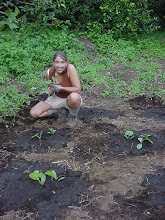
proof: me and my bare soil garden last fall


However, thanks to the kind advice of more experienced farmers than I, my eyes have been opened.
A weed by any other name, is MULCH:

Allowing weeds to sprout up around your crops creates a groundcover that holds in moisture (note: this applies to weeds of shorter stature than your desired crops) even if it does tend to look a little messy.
and when it is necessary to pull tall weeds, use them as regular MULCH, like i did here around mis melones:
All decomposing plant matter contains nutrients, so why not recycle unwanted plants?

And most impressively, weeds can act as CROP TRAPPINGS, as with my papaya sapling:
There are plants out there that are intended to bait pests, thus protecting the farmer's prized crops. in this case, a volunteer crop trapper showed up near my papaya--what a trooper! Not sure what plant it is, but i believe it's the same valiant fall guy pictured here with a baby tomato plant, again taking all the hits so that my cultivated baby can survive:
i guess it's tasty? The tiny round bites suggest an insect pest, though i have also found large jagged nibbles of the rabbit-mouth variety.
Keep up the good work, mis amigos!

martes, 26 de mayo de 2009

Las Tres Hermanas

As a gal with two brothers, perhaps i was especially drawn to the idyllic notion of a Three Sisters Garden. Or maybe it's remnant passion from my anthropology undergrad days--i was completely riveted for an entire semester of Native American "Indians," and to be honest i still maintain a fascination with any indigenous culture. OR just maybe, as i initiate myself into the cult of gardening, it is a right of passage to attempt this historical romantic and much-hyped traditional technique.
i did my research. many tout the awesome triad of responsibility that corn, squash, and beans share amongst each other in the garden:
CORN
the eldest sister, she provides strength and support,


SQUASH
with her wide-spreading vines and large leaves, squash acts as a living mulch, shading out potential weeds and holding in moisture for herself and her sisters,

and finally BEANS
the littlest sister winds her way up the corn stalk, and as a legume fixes nitrogen in the soil to feed her sisters.

SOUNDS groovy. however, lots of serious gardeners consider the three sisters gig to be an impractical, unproductive waste of space; they commonly argue these three (non-sisterly) points:
1) Corn is not always the sturdiest stake, and pole beans are an impressively aggressive climber. true story.
2) Scientific naysayers claim that the beans are technically not able to provide nitrogen to their sisters, as the nutritional benefit to the soil is reaped after the fact.
3) Lastly, the everyday farmer notes that tripping through tangled squash vines to harvest corn and beans is ANNOYING and UNNECESSARY.

Holding fast to my sister-less native-people-obsessed gullible-gardener persona, i embarked on the 3 sisters garden project regardless. the above fotos are MINE! after barely one month of transplanting the corn (golden bantam) and squash (saffron yellow), VOILA!
Different native american tribes reportedly grew the three sisters together, though in different patterns. I crafted my garden with interspersed mounds: corn and pole beans in one, squash in the other. i have also seen layouts with squash surrounding each corn/bean mound as well as a huge block of corn with beans and squash planted around the perimeter.
i unwittingly chose a non-spready squash variety, reducing treacherous foot trapping. the sweet corn got blown to heck in its early days, but gosh darnit if the lovely ladies aren't supporting pole beans AND sporting EARS already!!! mira:Without even having tasted the full bounty of el projecto de las tres hermanas, i am already hugely satisfied, pleased, and proud. Like all healthy sibling relationships, las tres no son perfectas...(the squash are bitter and full of seeds; the corn is way short; beans cannot grow to full height, etc) but that's family for ya. Does is it seem like somewhat of a pain in the ass? Yes. Do i LOVE the three sisters anyway? totally!
p.s. my rain dances are starting to pay off:
¡BIENVENIDOS A LA LLUVIA!

lunes, 11 de mayo de 2009

yerbas & spices

Through a process i like to call taste and error, i have come to learn and identify many old favorite flavors amongst a sea of new and unusual looking plants. This process is an integral part of my cultural immersion as plants have become something of a medium in my communication. i love cooking, i love el mercado, i love gardens, and i love plant nurseries. For these loves, i frequently plunge myself into awkward partially-intelligible conversations in which i'm sure i come across as a gringa loca; HOWEVER, i usually emerge with new and valuable knowledge of the aforementioned heart throbs.
Case in point numero uno: my quest for CILANTRO
A favorite of mine, i came into Nicaragua confident that cilantro was as spanishy as a word can get, an herb requisite in mexican cuisine, certainly an EASY FIND throughout all Latin America! Imagine my dismay when i scoured the market, inquiring constantly cilantro? Hay cilantro? Busco cilantro? and the ladies kept showing me this plant:
obviously NOT cilantro, to which i shook my head and kept searching, oblivious to the identical cilantro scent of Eryngium foetidum, commonly known as culantro (with a hard c, like a k) or Puerto Rican coriander. the above plant grows abundantly in our backyard and has become essential in all my soups, sauces, and salads.

Happily, I made the connection between mentha and mint on my own. despite the lack of any apparent physical similarity, the nose knows While i'm content using mentha in my mojitos, we all know this woody plant with rounded leaves is not a member of the authentic square-stem Mint Family. so what is it?

They handed me this one on a plate: Oregano
Plectranthus amboinicus

Also known as Cuban Oregano, Mexican Mint, and Spanish Thyme. Call it what you will, these guys propagate beautifully from cuttings and do wonders for a spaghetti sauce.

My garden boasts two basil varieties--again, smelling is believing.
The purplish leaves are tiny but pungent, and somehow i got the idea that this one is of Thai basil descent, but i haven't made an official identification yet. It does provide a fantastic flavor in combination with coconut milk, garlic, hot chiles, and one final herbal wonder in mi jardin:

Zacate Limón
Andropogon citratum

Nothing beats the zing of lemongrass in a Thai coconut soup! Not to mention its presence as a grassy bed end plant. Stalks are always available and will propagate readily.

martes, 28 de abril de 2009

Bicycle Water Pump

Since WATER is the biggest health issue in the world, it is no surprise that here in Nicaragua people, animals, and plants are all suffering from lack of this most vital nutrient. A brief study (5 minutes, by me) of recent water policy in the region revealed that somewhere between 50 and 80% of Nicaraguans have access to water, with the figures for sanitation of said water being much lower. I'm not about to try to understand the intricate web of bureaucracy and hypocrisy and politics that leaves so many people here without clean water. What i'm focusing on right now is our little town and my thirsty garden.
From what i am told, our water is derived from the ground, pumped and distributed by the water company who expects their bills paid in full and on time, regardless of how often water actually drips out of my sink and shower. Due to poorly functioning pumps, the municipal water supply is rationed--in town we usually have water 5 out of 7 days; however out at the farm, en el campo, water flows once every 7-15 days. muy malo. I assume people in this area store up water in whatever containers are at hand, partaking of their valuable resource sparingly. This time of year, dry season, everyone is especially parched, as is the land. No wonder i got so many bewildered faces when i zealously sowed vegetable seed back in March, in the midst of the Dry Hot No-Chance-Of-Rain Season.
Until now, my irrigation system has consisted of these simple tools, plus 2 girly biceps:
Slowly and methodically, sometimes meditatively, i bear water to mis plantitas.

While confident that lots of gardeners use watering cans so why can't i, the increasing heat and drying winds made my job harder and harder. i was haunted by the locals' voices: silly gringa, planting happens in June, the advent of the Wet Season.
Now, armed with almost a full year of weather watching, we are very much looking forward to the generous rains! Until then, and because we will still need potable water in la casita, a very cool project comes in:

BICYCLE WATER PUMP!
On the left under ground is a gigantic white 10,000 liter cistern, filled by the water company. A pipe will (soon) connect from the cistern up to the 2 black tanks on the tower--water will be pumped upward by sheer pedal power!

From there, good old gravity does its work to provide pressure for a beautiful new irrigation system (and from the other tank, water pressure into la casa!)
The inspiration for our crazy eco-bike pump came from here http://www.harvesth2o.com/pedaling.shtml
Huge thanks to our favorite farm interns, Bailey and Jocelyn, whose energy and time got this project off the ground, or rather out of the ground? ¡Muy amable, amigos!