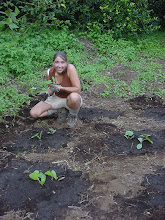


Although i've been something of an absentee farmer,on the farm growing must grow on! The rains have come and all plants are growing like cRaZy, whether i'm there to watch or not. Probably the most satisfying crop has been BEANS
sábado, 27 de junio de 2009
For about $2 i buy several pounds of beans at the market, toss them into the awaiting fertile ground, and before my very eyes they spring out of the earth!
 Here in Nicaragua RED beans rule, as a rule. The Nicaragua national dish, gallo pinto, is a red beans + rice combo; no other bean will suffice. Our neighbors to the south, Costa Rica, tout a gallo pinto of their own, more commonly with black beans. Nicas tend to be overly-possessive with the red bean thing and the Who-created-gallo pinto-issue is very sensitive. i personally will eat any and all beans, because they're ALL good. However in this household, our on-site cook has blatantly ignored the black beans i buy, even complaining to me that "there are NO beans," meaning no red beans. And my favorite Nica adamantly prefers los frijoles rojos over all others, going so far to claim that gallo pinto with black beans is not gallo pinto.
 Needless to say, we go through a LOT of beans. The bean return is supposedly 7lb to every 1lb planted; our goal is to grow a year's supply. This has been tricky to figure out, as gallo pinto is served with every meal.
I have many more updates, stay tuned!
and to provide some explanation for my absence, i plead monkey business :)


I have many more updates, stay tuned!
and to provide some explanation for my absence, i plead monkey business :)


viernes, 12 de junio de 2009
the good, the bad, and the ugly
Good: flowers are blooming! Calendula, Calendula officinalis
 Calendula, Calendula officinalis
  Borage, Borago officinalis
 African Marigolds, Tagetes erecta
 Girasol, Helianthus giganteus
Apparently it's possible to salvage your plant if the worm is removed early; in my Three Sisters Garden, it was too late.
On the upswing, while the zucchini plants were of no further use to me, they were a special treat for a new friend....
more Good: Introducing EZMERALDA!
 A voracious eater, Ezzie was happy to obliterate every last trace of my squash plants,
 not to mention, EVERY last piece of greenery in our backyard. Goats! there's no stopping 'em!
Finalamente, the Ugly
 All three varieties of the tomatoes i planted are exhibiting classic signs of the fungus Early Blight. note the yellowed to brown circular spots.
Tomatoes have been the thorn in my side since the beginning (remember the UC-82s??) so maybe i'm not even surprised. Early Blight feeds on moisture, and unfortunately thrives in areas with heavy WEEDS. oooops. so much for my pro-weedy garden campaign.
The other huge mistake i made was planting tomatoes in the same darn garden plot--the fungus was most likely living in the soil since the first tomato crop. arrrgh.
still, the grape tomatoes continue to produce fruit.
 ¿fruta fea?
viernes, 5 de junio de 2009
fruity
Cool fruits you don't see every day (that i do):
 Inga edulis
Inside the massive green pods of the guaba tree, seeds are encased in a velvety white EDIBLE flesh! One taste and you'll understand why it is nicknamed the "cotton candy fruit."
 There is huge confusion around the name of this fruit. According to the books it is guaba, but is referred to here in Nicaragua as guayaba.
However, guayaba is translated as the spanish word for guava, a distinctly different fruit with juicy pink fruit and green skin.
Luckily, i enjoy both fruits so whatever i call it, or they call it, i'll eat it!
This might be the weirdest one yet:
 Anacardium occidentale
Would you have guessed that this is the fruit and nut we call cashew??! Although the nut has gained international popularity, Nicas rave about cashew fruit and frequently grow the tree for the fruit only. It gets weirder: the nut, or seed, of a cashew is protected in the brownish cashew-shaped shell; inside the shell is a dangerous liquid containing the chemical urushiol, the same irritant in poison oak and ivy: cuidado! The common allergen may seriously injure your skin, not to mention your mouth. For this reason cashews are opened by roasting, steaming, or boiling, a process that should not be undertaken lightly.
 Personally, i don't love cashew fruit. the flesh is pulpy, too smooshy for me and not sweet enough.
This one ain't so strange, though you might not recognize it so close up:

how about now?
 Cucumis melo reticulatus is regular old canteloupe, and my plant is finally fruiting!!!!!
And, your everyday banana tree, in all its splendor:

 Inga edulis
Inside the massive green pods of the guaba tree, seeds are encased in a velvety white EDIBLE flesh! One taste and you'll understand why it is nicknamed the "cotton candy fruit."
 There is huge confusion around the name of this fruit. According to the books it is guaba, but is referred to here in Nicaragua as guayaba.
 However, guayaba is translated as the spanish word for guava, a distinctly different fruit with juicy pink fruit and green skin.
Luckily, i enjoy both fruits so whatever i call it, or they call it, i'll eat it!
This might be the weirdest one yet:
 Anacardium occidentale
Would you have guessed that this is the fruit and nut we call cashew??! Although the nut has gained international popularity, Nicas rave about cashew fruit and frequently grow the tree for the fruit only.
 It gets weirder: the nut, or seed, of a cashew is protected in the brownish cashew-shaped shell; inside the shell is a dangerous liquid containing the chemical urushiol, the same irritant in poison oak and ivy: cuidado! The common allergen may seriously injure your skin, not to mention your mouth. For this reason cashews are opened by roasting, steaming, or boiling, a process that should not be undertaken lightly.
 Personally, i don't love cashew fruit. the flesh is pulpy, too smooshy for me and not sweet enough.
This one ain't so strange, though you might not recognize it so close up:

how about now?
 Cucumis melo reticulatus is regular old canteloupe, and my plant is finally fruiting!!!!!
And, your everyday banana tree, in all its splendor:

jueves, 4 de junio de 2009
out of the garden, into the frying pan
The past few months of gardening I've been testing different seeds, various varieties of my favorite vegetables, most of which i purchased in the U.S. For this reason i've planted sparingly, noting which plants are adaptable to the hot tropical climate, which are pest-resistant, which are tasty, etc. Later i will know which varieties i want to plant in great quantities.
i came home the other day with my latest harvest, eager to cook up a farm-fresh meal!
except,
this was my bountiful cornucopia:
 Succotash?
Luckily, i have access to an excellent local market where other farmers regularly bring in diverse harvests! So with a little help from my friends,
 and this friend,

 My corn and zucchini, plus broccoli, peppers, onion, carrots, and cabbage quickly fried in olive oil, tossed with a garlic, ginger, and soy sauce combo, toasted cashews on top, all served over brown rice:
 One day i hope to grow such a gorgeous array myself!
I tried garlic earlier this year; somehow it all disappeared. rabbits? And ginger grows here as well, though i haven't been able to get its watering needs right. keep on keeping on, eh?
I am bringing in a larger percentage of this delicious Italian favorite:
BASIL ALMOND PESTO
 1 large bunch of basil
1 head garlic
1/4 cup almonds
1/2 cup olive oil
salt and pepper
 3) Blend all ingredients in blender or food processor (sorry i have no photos of this, but i'm sure you can picture it), adding salt and pepper to taste
 4) Spread pesto onto homemade carrot bread
 and find a taste-tester
 Success!
I used almonds because pine nuts are unknown in these parts, as is fresh parmesan. i've also heard of using walnuts, but you don't see those around here either.
i came home the other day with my latest harvest, eager to cook up a farm-fresh meal!
except,
this was my bountiful cornucopia:
 Succotash?
Luckily, i have access to an excellent local market where other farmers regularly bring in diverse harvests! So with a little help from my friends,
 and this friend,
dinner began to take shape.
 My corn and zucchini, plus broccoli, peppers, onion, carrots, and cabbage quickly fried in olive oil, tossed with a garlic, ginger, and soy sauce combo, toasted cashews on top, all served over brown rice:
 One day i hope to grow such a gorgeous array myself!
I tried garlic earlier this year; somehow it all disappeared. rabbits? And ginger grows here as well, though i haven't been able to get its watering needs right. keep on keeping on, eh?
I am bringing in a larger percentage of this delicious Italian favorite:
BASIL ALMOND PESTO
 1 large bunch of basil
1 head garlic
1/4 cup almonds
1/2 cup olive oil
salt and pepper
1) Separate basil leaves from stems and rinse well; peel garlic
2) Toast almonds (if raw) in an ungreased skillet over high heat, stirring CONSTANTLY, until golden brown
2) Toast almonds (if raw) in an ungreased skillet over high heat, stirring CONSTANTLY, until golden brown
 3) Blend all ingredients in blender or food processor (sorry i have no photos of this, but i'm sure you can picture it), adding salt and pepper to taste
 4) Spread pesto onto homemade carrot bread
 and find a taste-tester
 Success!
I used almonds because pine nuts are unknown in these parts, as is fresh parmesan. i've also heard of using walnuts, but you don't see those around here either.
domingo, 31 de mayo de 2009
natural born killer?
Organic Farming is a concept that, for me, has always conjured up associations like healthy, natural, ecologically-friendly, for the most part peaceful images. Well, I'm only a few months into this, but i'm learning fast: organic gardening is BRUTAL. by brutal i mean bloody. If you want plants to grow, other things have to DIE, it's cut-throat, people!
This is coming from a gal who consciously avoids ants on the sidewalk; who painstakingly removes spiders from inside the house in a jar in order to release them outdoors; a firm believer in karma!
Everything changed when i met Enemy #1
 Anasa tristis
Enter the aptly if not creatively named Squash Bug: a pest who lives to suck the juices out of poor innocent squash, cucumber, and melon plants, reducing them to shriveled yellow shells of their former selves. In larger more-developed plants, the squash bug may only cause minor damage. However smaller, weaker plants are lambs to the slaughter, which i fear is the case with my yellow saffron summer squash, pictured here:
 At first hesitant to blame the colorful cheery little buggers, internet research left no doubt: my squash was under attack. And the squash bugs were not acting alone. oh no.
HA! with rapid response time and spot-on hand-eye coordination, a squash bug meets its demise
 A once-timid bodhisattva, i am transformed into a bloodthirsty killing machine.
From what I understand, organic pest control is not hugely successful with either of these pests. In the squash foto above, see the wooden boards i set out as traps--if i get to the farm early enough in the morning, the squash bugs that were lured into my trap are an easy kill. Otherwise, i really am spraying a yummy garlic/chile mixture that is washed off every night in heavy rains :(
Anyone have advice? Is there any more i can do? In a climate where the season never really "ends," i'm nervous that the pest populations may continue ad nauseam....
This is coming from a gal who consciously avoids ants on the sidewalk; who painstakingly removes spiders from inside the house in a jar in order to release them outdoors; a firm believer in karma!
Everything changed when i met Enemy #1
 Anasa tristis
Enter the aptly if not creatively named Squash Bug: a pest who lives to suck the juices out of poor innocent squash, cucumber, and melon plants, reducing them to shriveled yellow shells of their former selves. In larger more-developed plants, the squash bug may only cause minor damage. However smaller, weaker plants are lambs to the slaughter, which i fear is the case with my yellow saffron summer squash, pictured here:
 At first hesitant to blame the colorful cheery little buggers, internet research left no doubt: my squash was under attack. And the squash bugs were not acting alone. oh no.
Enter Enemy #2: Acalymma vittatum
Besting any of James Bond's femme fatales, Striped Cucumber Beetles dazzle and distract with their showy good looks all the while eating to death beloved yellow squash and zucchinis.
According to online garden advice, both of these pests are formidable enemies. Though i advanced with chemical warfare (my homemade garlic/chile spray) it was apparent that hand-to-hand combat was in order.
WARNING: THE FOLLOWING IMAGE MAY NOT BE SUITABLE FOR SENSITIVE VIEWERS
 Acalymma vittatum
Besting any of James Bond's femme fatales, Striped Cucumber Beetles dazzle and distract with their showy good looks all the while eating to death beloved yellow squash and zucchinis.
According to online garden advice, both of these pests are formidable enemies. Though i advanced with chemical warfare (my homemade garlic/chile spray) it was apparent that hand-to-hand combat was in order.
WARNING: THE FOLLOWING IMAGE MAY NOT BE SUITABLE FOR SENSITIVE VIEWERS
HA! with rapid response time and spot-on hand-eye coordination, a squash bug meets its demise
 A once-timid bodhisattva, i am transformed into a bloodthirsty killing machine.
From what I understand, organic pest control is not hugely successful with either of these pests. In the squash foto above, see the wooden boards i set out as traps--if i get to the farm early enough in the morning, the squash bugs that were lured into my trap are an easy kill. Otherwise, i really am spraying a yummy garlic/chile mixture that is washed off every night in heavy rains :(
Anyone have advice? Is there any more i can do? In a climate where the season never really "ends," i'm nervous that the pest populations may continue ad nauseam....
jueves, 28 de mayo de 2009
friends in low places
Weeds have such a bad name. as in, bad reputation. There is an entire industry bent on killing, removing, destroying, eradicating weeds, the unwelcome guests at every garden party. And i admit, i was amongst the ranks of such weed-haters not so long ago. Encroaching on my precious cultivated beds, pesky, sometimes spikey persistent invadors! i diligently plucked every eager weed that dare to sprout in my garden plot.
A weed by any other name, is MULCH:
 Allowing weeds to sprout up around your crops creates a groundcover that holds in moisture (note: this applies to weeds of shorter stature than your desired crops) even if it does tend to look a little messy.
and when it is necessary to pull tall weeds, use them as regular MULCH, like i did here around mis melones:
 All decomposing plant matter contains nutrients, so why not recycle unwanted plants?
And most impressively, weeds can act as CROP TRAPPINGS, as with my papaya sapling:
 There are plants out there that are intended to bait pests, thus protecting the farmer's prized crops. in this case, a volunteer crop trapper showed up near my papaya--what a trooper! Not sure what plant it is, but i believe it's the same valiant fall guy pictured here with a baby tomato plant, again taking all the hits so that my cultivated baby can survive:
 i guess it's tasty? The tiny round bites suggest an insect pest, though i have also found large jagged nibbles of the rabbit-mouth variety.
Keep up the good work, mis amigos!
proof: me and my bare soil garden last fall
However, thanks to the kind advice of more experienced farmers than I, my eyes have been opened.
A weed by any other name, is MULCH:
 Allowing weeds to sprout up around your crops creates a groundcover that holds in moisture (note: this applies to weeds of shorter stature than your desired crops) even if it does tend to look a little messy.
and when it is necessary to pull tall weeds, use them as regular MULCH, like i did here around mis melones:
 All decomposing plant matter contains nutrients, so why not recycle unwanted plants?
And most impressively, weeds can act as CROP TRAPPINGS, as with my papaya sapling:
 There are plants out there that are intended to bait pests, thus protecting the farmer's prized crops. in this case, a volunteer crop trapper showed up near my papaya--what a trooper! Not sure what plant it is, but i believe it's the same valiant fall guy pictured here with a baby tomato plant, again taking all the hits so that my cultivated baby can survive:
 i guess it's tasty? The tiny round bites suggest an insect pest, though i have also found large jagged nibbles of the rabbit-mouth variety.
Keep up the good work, mis amigos!
martes, 26 de mayo de 2009
Las Tres Hermanas
As a gal with two brothers, perhaps i was especially drawn to the idyllic notion of a Three Sisters Garden. Or maybe it's remnant passion from my anthropology undergrad days--i was completely riveted for an entire semester of Native American "Indians," and to be honest i still maintain a fascination with any indigenous culture. OR just maybe, as i initiate myself into the cult of gardening, it is a right of passage to attempt this historical romantic and much-hyped traditional technique.
i did my research. many tout the awesome triad of responsibility that corn, squash, and beans share amongst each other in the garden:

 the littlest sister winds her way up the corn stalk, and as a legume fixes nitrogen in the soil to feed her sisters.
i did my research. many tout the awesome triad of responsibility that corn, squash, and beans share amongst each other in the garden:
CORN
 the eldest sister, she provides strength and support,
 the eldest sister, she provides strength and support,
SQUASH

with her wide-spreading vines and large leaves, squash acts as a living mulch, shading out potential weeds and holding in moisture for herself and her sisters,
and finally BEANS
and finally BEANS
 the littlest sister winds her way up the corn stalk, and as a legume fixes nitrogen in the soil to feed her sisters.
SOUNDS groovy. however, lots of serious gardeners consider the three sisters gig to be an impractical, unproductive waste of space; they commonly argue these three (non-sisterly) points:
1) Corn is not always the sturdiest stake, and pole beans are an impressively aggressive climber. true story.
2) Scientific naysayers claim that the beans are technically not able to provide nitrogen to their sisters, as the nutritional benefit to the soil is reaped after the fact.
3) Lastly, the everyday farmer notes that tripping through tangled squash vines to harvest corn and beans is ANNOYING and UNNECESSARY.
Holding fast to my sister-less native-people-obsessed gullible-gardener persona, i embarked on the 3 sisters garden project regardless. the above fotos are MINE! after barely one month of transplanting the corn (golden bantam) and squash (saffron yellow), VOILA!
Different native american tribes reportedly grew the three sisters together, though in different patterns. I crafted my garden with interspersed mounds: corn and pole beans in one, squash in the other. i have also seen layouts with squash surrounding each corn/bean mound as well as a huge block of corn with beans and squash planted around the perimeter.
i unwittingly chose a non-spready squash variety, reducing treacherous foot trapping. the sweet corn got blown to heck in its early days, but gosh darnit if the lovely ladies aren't supporting pole beans AND sporting EARS already!!! mira: Without even having tasted the full bounty of el projecto de las tres hermanas, i am already hugely satisfied, pleased, and proud. Like all healthy sibling relationships, las tres no son perfectas...(the squash are bitter and full of seeds; the corn is way short; beans cannot grow to full height, etc) but that's family for ya. Does is it seem like somewhat of a pain in the ass? Yes. Do i LOVE the three sisters anyway? totally!
p.s. my rain dances are starting to pay off:
1) Corn is not always the sturdiest stake, and pole beans are an impressively aggressive climber. true story.
2) Scientific naysayers claim that the beans are technically not able to provide nitrogen to their sisters, as the nutritional benefit to the soil is reaped after the fact.
3) Lastly, the everyday farmer notes that tripping through tangled squash vines to harvest corn and beans is ANNOYING and UNNECESSARY.
Holding fast to my sister-less native-people-obsessed gullible-gardener persona, i embarked on the 3 sisters garden project regardless. the above fotos are MINE! after barely one month of transplanting the corn (golden bantam) and squash (saffron yellow), VOILA!
Different native american tribes reportedly grew the three sisters together, though in different patterns. I crafted my garden with interspersed mounds: corn and pole beans in one, squash in the other. i have also seen layouts with squash surrounding each corn/bean mound as well as a huge block of corn with beans and squash planted around the perimeter.
i unwittingly chose a non-spready squash variety, reducing treacherous foot trapping. the sweet corn got blown to heck in its early days, but gosh darnit if the lovely ladies aren't supporting pole beans AND sporting EARS already!!! mira:
 Without even having tasted the full bounty of el projecto de las tres hermanas, i am already hugely satisfied, pleased, and proud. Like all healthy sibling relationships, las tres no son perfectas...(the squash are bitter and full of seeds; the corn is way short; beans cannot grow to full height, etc) but that's family for ya. Does is it seem like somewhat of a pain in the ass? Yes. Do i LOVE the three sisters anyway? totally!
 p.s. my rain dances are starting to pay off:
¡BIENVENIDOS A LA LLUVIA!
Suscribirse a:
Entradas (Atom)